An activated carbon water filter is the most common home filter, and it is excellent at what it does: removing chlorine, improving taste and odor, and reducing many organic chemicals. What it does not do is remove dissolved minerals, fluoride, or salts, and a basic version may miss some heavy metals unless it is certified for them. Knowing that line, what carbon catches and what it misses, tells you whether it is enough for your water.
Key takeaways
– Activated carbon removes over 95% of chlorine and reduces VOCs, taste, and odor very effectively.
– It does not remove fluoride, nitrates, or dissolved minerals (total dissolved solids); reverse osmosis is needed for those.
– Check certification: NSF/ANSI 42 covers taste and odor only, while NSF/ANSI 53 covers health contaminants like lead and VOCs.
How activated carbon works
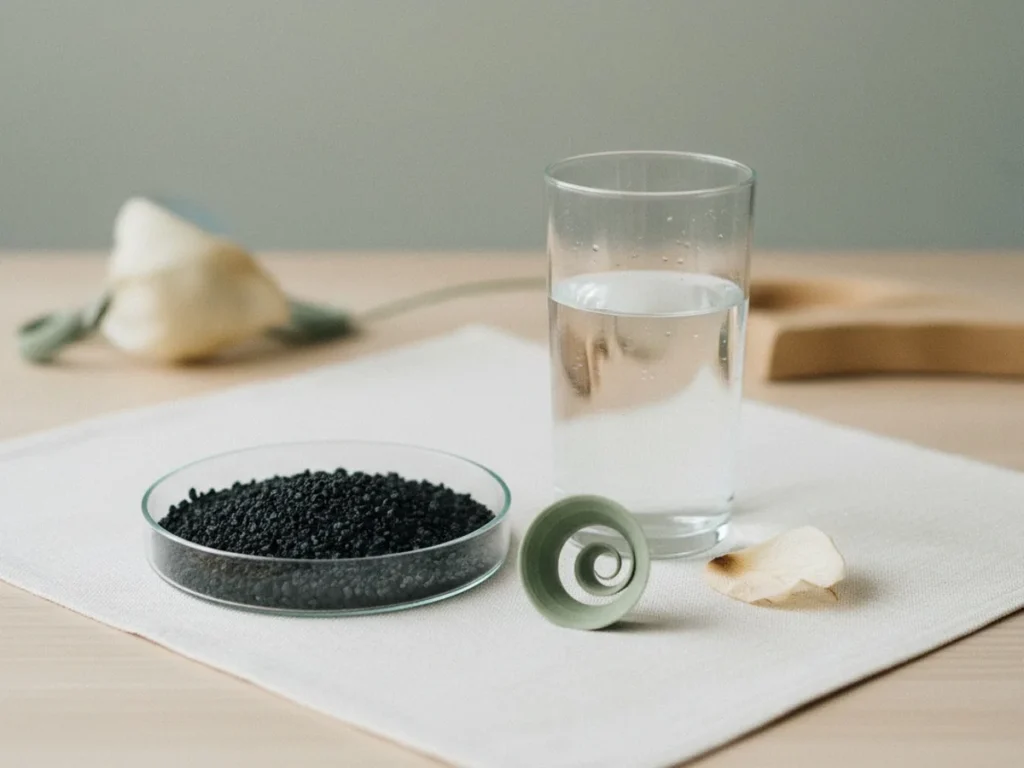
Activated carbon is processed to be extremely porous, giving a small amount of material an enormous internal surface area. As water passes through, contaminants stick to that surface in a process called adsorption. Carbon comes in two main forms: granular activated carbon (loose granules, common in pitchers) and carbon block (compressed, finer, used in better under-sink and countertop filters). Carbon block filters more thoroughly because the dense structure also strains particles.
What it removes well
Carbon shines on the things that affect taste, smell, and many organic pollutants. It removes more than 95% of free chlorine, takes out chlorine taste and odor, and reduces volatile organic compounds (VOCs) such as benzene and toluene by large margins in certified filters. Better carbon-block filters certified to NSF/ANSI 53 also reduce lead, some pesticides, and even some PFAS, and a fine carbon block helps with microplastics. See water filters for microplastics.
What it does not remove
Carbon’s limits are just as important. It does not remove dissolved minerals or salts, so it will not lower total dissolved solids (TDS). It does not remove fluoride or nitrates. A basic granular pitcher may not reliably remove heavy metals or microbes. For those, you need a different technology, usually reverse osmosis, which uses a much finer membrane. See reverse osmosis filters.
Reading the certifications
The certification tells you what a carbon filter has actually been proven to do. NSF/ANSI 42 covers aesthetic effects only, chlorine taste and odor, and explicitly excludes health contaminants. NSF/ANSI 53 covers health-related contaminants such as lead, certain VOCs, and cysts. So two carbon filters can look identical but perform very differently: if you care about lead or chemicals, look specifically for NSF/ANSI 53, not just 42.
Is carbon enough for your water
For many people on treated municipal water, a good carbon-block filter certified to NSF 53 is enough to improve taste and cut chlorine, lead, and many organics. If your testing shows high fluoride, nitrates, arsenic, or you are on a private well, carbon alone will not cover it and reverse osmosis is the better fit. Start by checking your water report or testing, then match the filter to what is actually present. See choosing a water filter for microplastics and PFAS.
FAQ
What does an activated carbon water filter remove?
It removes chlorine (over 95%), chlorine taste and odor, and many VOCs, and better carbon-block filters certified to NSF 53 also reduce lead, some pesticides, and some PFAS. It is one of the most effective filters for taste and organic chemicals.
Does activated carbon remove fluoride?
No. Standard activated carbon does not remove fluoride, nitrates, or dissolved minerals. To reduce fluoride you need reverse osmosis or a specialty media like activated alumina.
Is carbon block better than granular carbon?
Generally yes. A carbon block is denser and finer, so it both adsorbs chemicals and strains small particles, including many microplastics. Loose granular carbon in basic pitchers filters less thoroughly.
What is the difference between NSF 42 and NSF 53?
NSF/ANSI 42 covers aesthetic issues only, like chlorine taste and odor, and excludes health contaminants. NSF/ANSI 53 covers health-related contaminants such as lead and certain VOCs. For health concerns, look for NSF 53.
Does a carbon filter remove total dissolved solids (TDS)?
No. Carbon does not lower TDS, because it does not remove dissolved salts and minerals. If your goal is to reduce TDS, fluoride, or nitrates, you need a reverse osmosis system instead.
The bottom line
An activated carbon filter is a great, affordable choice for better-tasting water and for cutting chlorine and many chemicals, and a certified carbon block reaches lead and some PFAS too. Just know its limits: for fluoride, nitrates, or high dissolved solids, step up to reverse osmosis. Match the filter to your actual water, and check for NSF/ANSI 53. See the best water filter for microplastics.