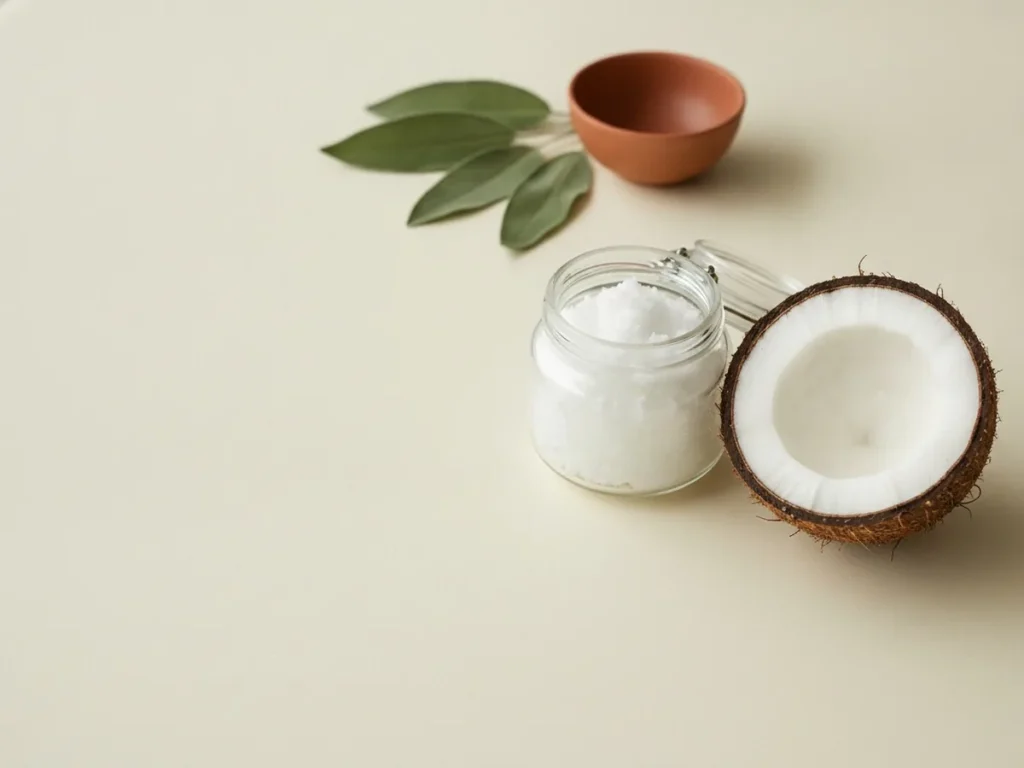
No, coconut oil itself is not a proven endocrine disruptor. The hormone scare you saw is really about something else: phthalate contamination found in a handful of coconut oil products, not the oil itself. Evidence that coconut oil disrupts your hormones is Limited.
Key takeaways
– Coconut oil, the fat, is not classified as an endocrine disruptor. Several clean-living sources actually list it as a safer swap.
– The viral worry comes from a 2024 consumer test that found phthalates in coconut oil products. Phthalates are real endocrine disruptors, but they are a contaminant, not the oil.
– That test checked 7 oils and found trace phthalates in all of them, from 134 to 1,331 parts per billion (ppb). It was a spot-check, not peer-reviewed research.
– Direct hormone studies on coconut oil are mostly animal and lab work, with mixed results and no human evidence of endocrine disruption from normal use.
– The practical fix is about packaging and processing: choose oil in glass, avoid plastic-lined containers, and pick brands that test for purity.Evidence strength: Limited. No human evidence that coconut oil disrupts endocrine function. The phthalate finding comes from one non-peer-reviewed consumer test, and the direct hormone research is animal and in-vitro only.
Why people think coconut oil is a hormone problem
If you searched this, you probably saw a reel or a headline like “If you use coconut oil, stop and listen.” Those videos trace back to one report: in June 2024, the consumer group Mamavation, working with Environmental Health News, tested popular coconut oils and found phthalates in every sample (EHN, 2024).
Here’s the part the headlines skip. Phthalates are not coconut oil. They are plasticizer chemicals that leach in from plastic tubing, gaskets, and packaging during processing. So the question splits in two: is the oil itself a disruptor (the research says no), and did some products pick up a disruptor along the way (this one test says yes, in trace amounts). Most articles ranking for this question blur those two things together. We are going to keep them apart.
What the research actually shows
Coconut oil itself has not been shown to disrupt human hormones. The phthalate contamination is a separate, real, but small finding.
- Coconut oil is not classified as an endocrine disruptor. Clean-beauty and functional-medicine sources repeatedly list it as a safer alternative to known disruptors, used as a plain moisturizer rather than something to avoid (Rupa Health, 2022).
- The phthalate finding is a consumer spot-check, not peer-reviewed science. Mamavation’s EPA-certified lab tested 7 coconut oils and found phthalates in all of them, ranging from 134 ppb to 1,331 ppb. Four of the seven came in under 400 ppb. The group itself states this was a “spot-check,” not peer-reviewed research (Mamavation, 2024).
- Phthalates, the contaminant, are genuine endocrine disruptors. The most common one detected, DEHP, can lower testosterone, interfere with estrogen, and is linked to reproductive harm. They enter food mainly through packaging, and fatty foods like oils absorb them more readily (Endocrine Society).
- Direct hormone studies on coconut oil are animal and lab work, with mixed signals. One 2025 animal study found that prolonged coconut oil feeding reduced steroid-making enzymes and shifted estrogen receptor balance in the adrenal cortex of Mongolian gerbils, which is animal evidence, not human (Food and Chemical Toxicology, 2025; PMID 39793945). In lab assays, free fatty acids including lauric acid, the main fat in coconut oil, can inhibit 5-alpha-reductase, the enzyme that makes DHT (Raynaud et al., Journal of Steroid Biochemistry and Molecular Biology, 2002; PMID 12477490). None of this has been shown to disrupt hormones in people at normal dietary or topical amounts.
For the authoritative definition of what actually counts as an endocrine disruptor, the NIEHS overview is the reference point (NIEHS). Coconut oil is not on its list. Phthalates are.
The substance versus the contaminant
| Coconut oil (the fat) | Phthalates (the contaminant) | |
|---|---|---|
| Is it an endocrine disruptor? | Not proven. No human evidence. | Yes, well documented. |
| Where it comes from | The coconut | Plastic processing equipment and packaging |
| Strength of evidence | Limited, animal and in-vitro only | Strong, human and regulatory |
| What to do about it | Use normally | Choose glass-packaged, tested brands |
How exposure actually happens
For the oil itself, exposure is just normal use: cooking, or on skin and hair. There is no established hormone risk at those amounts.
For the phthalate angle, exposure depends on the product, not the recipe. Phthalates migrate into oil from plastic tubing and packaging during manufacturing and storage. Because oil is fatty, it pulls in more than watery foods do. The levels found in the 2024 test were in parts per billion, which is very low, but for phthalates many researchers argue there is no clearly “safe” dose, so reducing avoidable exposure is reasonable.
Who should care most
- Pregnancy and trying to conceive. Phthalates are the real concern in pregnancy, not coconut oil. They are linked to reproductive and developmental effects, so choosing glass-packaged, tested oils is a sensible exposure-reduction step. This is information, not medical advice.
- Infants and young children. Same logic: the worry is the phthalate contaminant, so favor cleaner-tested brands for anything used in cooking or on a child’s skin.
- Everyday cooks and skincare users. For the oil itself, current evidence does not support a hormone worry. Buying clean is about avoiding the plasticizer hitchhikers, not the coconut.
Safer swaps
If you want coconut oil without the phthalate question mark:
- A cold-pressed, organic coconut oil sold in glass rather than plastic-lined containers
- A brand that publishes third-party purity or phthalate testing
- For cooking, a glass-bottled olive or avocado oil if you would rather sidestep the coconut oil contamination story entirely
Related questions
- Is tea tree oil an endocrine disruptor?
- Is rosemary oil an endocrine disruptor?
- Are phthalates in food packaging dangerous?
- Is fractionated coconut oil toxic?
FAQ
Is coconut oil bad for your hormones?
For the oil itself, there is no human evidence it disrupts hormones. The hormone studies that exist are in animals and cells, with mixed results, at amounts far above normal use. The real concern raised online is phthalate contamination in some products, which is a packaging issue, not the oil.
Why is there phthalate in coconut oil?
Phthalates are not part of coconut oil. They leach in from plastic equipment, tubing, and packaging during processing and storage. Because oil is fatty, it absorbs more of these plasticizers than watery foods do. A 2024 consumer test found trace phthalates, 134 to 1,331 ppb, in all seven oils it checked.
Which coconut oil is safest from phthalates?
Choose cold-pressed, organic coconut oil packaged in glass rather than plastic, from a brand that publishes third-party purity testing. Glass packaging avoids the main route phthalates use to get into oil. The 2024 spot-check was small, so brand testing matters more than any single ranking list of “worst” brands.
Is fractionated coconut oil an endocrine disruptor?
There is no evidence that fractionated coconut oil itself disrupts hormones. It is regular coconut oil with the long-chain fats removed, leaving mostly medium-chain fats. As with regular coconut oil, the only real contamination concern is phthalates from processing or packaging, not the oil itself.
Do phthalates in coconut oil actually affect you?
Phthalates are documented endocrine disruptors that can affect testosterone, estrogen, and reproduction. The levels found in coconut oil were very low, in parts per billion. For phthalates, many researchers say no exposure is clearly risk-free, so reducing avoidable sources is reasonable, especially during pregnancy. This is exposure information, not medical advice.
Written by Luc Dossis, founder of Toxlens. Reviewed 2026-06-10. See how we grade the evidence in our methodology. This is exposure-reduction information, not medical advice.