You do not need a 12-piece set to cook safely. You need the right three or four pieces in the right materials.
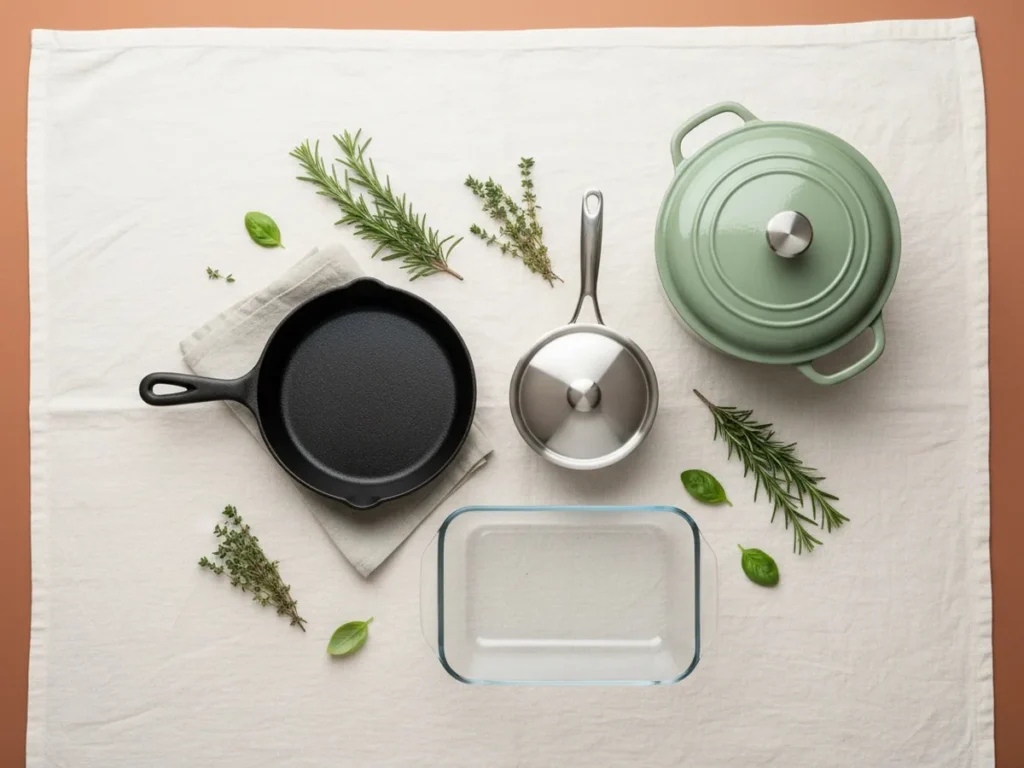
The best non-toxic cookware set is not a single boxed bundle at all. It is a small, deliberate line-up built from a few proven materials: stainless tri-ply, cast iron, enameled cast iron, carbon steel, and glass. These materials are stable, well understood, and free of the fluorinated coatings that draw people to “non-toxic” shopping in the first place. This guide shows you what a safe set should actually include, how to judge any set on the shelf, and how to assemble one piece by piece without overpaying for pans you will never use.
Key takeaways
- Most home cooks need only 3 to 4 pieces, not the 10 to 12 in a typical boxed set. A skillet, a saucepan, a stockpot or Dutch oven, and one extra pan cover the vast majority of meals.
- Material is the whole decision. Stainless tri-ply, bare cast iron, enameled cast iron, carbon steel, and oven-safe glass are the core safe materials, because none of them rely on a fluorinated nonstick coating.
- “PFOA-free” is not the same as “PFAS-free.” PFOA was phased out of US nonstick production years ago, so PFOA-free is now the baseline, not a safety feature. Look for sets that state no PFAS at all.
- Buy a set the way you would build a toolkit: choose each piece by the job it does, confirm the stated material, and skip the filler lids and tiny pans that pad the piece count.
What makes a cookware set “non-toxic”?
“Non-toxic” is a marketing phrase, not a regulated standard, so it pays to translate it into something concrete: a set built from materials that stay stable under normal cooking heat and do not shed synthetic coatings into food.
The concern that sends most people looking is PFAS, the family of fluorinated chemicals used in conventional nonstick coatings. According to the US EPA, eight major companies joined the 2010/2015 PFOA Stewardship Program and met the goal of eliminating PFOA from US production by the end of 2015, with Teflon-branded products reported PFOA-free since 2013. That is genuine progress, but it addresses one chemical (PFOA), not the broader PFAS category or the coating itself. This is why “PFOA-free” on a box tells you very little today. For the fuller picture, see our explainer on what PFAS are and our guide to PFAS in cookware.
The safe materials avoid the question entirely. Stainless steel, cast iron, enameled cast iron, carbon steel, and glass do not use fluorinated coatings, so there is no coating to break down. A non-toxic set, in plain terms, is one assembled from these materials.
What materials make the safest set?
Each safe material has a job it does best. A strong set usually combines two or three of them rather than relying on one.
Stainless tri-ply is the workhorse. Tri-ply means a layer of aluminum sandwiched between two layers of stainless steel for even heating. Food-grade stainless (often labeled 18/10 or 304) is non-reactive, so it handles tomatoes, wine, and citrus without taking on a metallic taste. It is the most versatile base for any set.
Bare cast iron is durable, oven-safe, and builds a natural seasoned surface that releases food well over time. It does transfer a small amount of iron into food, which is harmless for most people and is one reason cast iron is so well regarded for everyday searing and baking.
Enameled cast iron is cast iron coated in a glass-based enamel. It gives you cast iron’s heat retention without the seasoning routine, and the enamel is non-reactive, which makes it ideal for long-simmered, acidic dishes like tomato sauce or braises.
Carbon steel behaves like a lighter, more responsive cast iron. It seasons the same way, heats quickly, and is the classic choice for high-heat searing and stir-frying.
Oven-safe glass rounds things out for baking and storage. It is inert and non-reactive, which is why it is a reliable choice for casseroles and leftovers.
How big a cookware set do you actually need?
Far smaller than the box suggests. A “12-piece set” usually counts lids as pieces and includes duplicate small pans, so the real cooking surfaces are often only five or six. Most households genuinely use three or four.
Here is what a safe set should include, organized by the job each piece does:
| Kitchen job | Piece | Best material | Why this material |
|---|---|---|---|
| Everyday frying, eggs, sauteing | 10 to 12 inch skillet | Cast iron or carbon steel | Builds a natural release surface, handles high heat, no coating to wear out |
| Searing meat, pan sauces, tomato-based dishes | 10 inch fry pan | Stainless tri-ply | Non-reactive with acidic foods, even heating, oven-safe |
| Sauces, grains, reheating, boiling | 2 to 3 quart saucepan | Stainless tri-ply | Precise control, non-reactive, easy to clean |
| Soups, stews, braises, pasta water | 5 to 7 quart Dutch oven or stockpot | Enameled cast iron (Dutch oven) or stainless (stockpot) | Heat retention for slow cooking; enamel is non-reactive for long simmers |
| Baking, casseroles, storage | Baking dish | Oven-safe glass | Inert, non-reactive, doubles as storage |
If you cook simple weeknight meals, the first three pieces may be all you ever reach for. Add the Dutch oven and a glass dish only if you braise or bake regularly.
What should you look for when buying a set?
Use these checks to judge any set, boxed or assembled piece by piece.
- Clearly stated materials. The listing should name the exact material, such as “18/10 stainless tri-ply” or “enameled cast iron,” not vague terms like “premium alloy” or “healthy coating.”
- PFAS-free, not just PFOA-free. Since PFOA was already phased out of US production by 2015, treat “PFOA-free” as the bare minimum. Prefer wording that states no PFAS at all.
- Lead-and-cadmium-tested enamel. For enameled pieces, look for confirmation the enamel is tested to meet FDA limits. The FDA tests ceramicware for leachable lead using a 4 percent acetic acid soak, with action levels such as 3.0 mg/L for flatware and 0.5 mg/L for cups and mugs, so reputable enamelware brands will state compliance.
- Oven-safe ratings and solid handles. Riveted stainless or integral cast handles outlast glued or plastic ones, and a high oven rating signals the piece has no temperature-sensitive coating.
What should you avoid in a cookware set?
The clearest thing to avoid is the giant coated set that wins on piece count and loses on lifespan. Conventional nonstick coatings wear down, and once the surface is damaged the case for replacing it gets stronger.
A 2022 study published in Science of the Total Environment used Raman imaging to estimate that a single scratch on a Teflon-style nonstick surface can release roughly 9,100 plastic particles, and that a broken coating can release far more. Separately, PTFE coatings begin to break down and release fumes when overheated past about 500 degrees Fahrenheit (260 degrees Celsius), which is why high-heat searing is a poor match for coated pans. None of this applies to bare metal, cast iron, or glass, which is the practical reason to build a set from those materials instead. If you are phasing out older coated pans, our guide on how to avoid PFAS walks through sensible swaps.
Also skip sets padded with pieces you will not use: a tiny 1-quart saucepan, a third skillet, or counted-as-pieces lids. They inflate the price and the cabinet clutter without adding real capability.
How do you assemble a safe set piece by piece?
Buying individually often costs less than a premium boxed set and gives you exactly the pieces you use. A practical order:
- Start with one skillet. A 10 to 12 inch cast iron or carbon steel skillet is the single most useful pan and the easiest to live with day to day.
- Add a stainless tri-ply saucepan. A 2 to 3 quart saucepan covers sauces, grains, and reheating with precise control.
- Add a larger pot. A 5 to 7 quart enameled cast iron Dutch oven for braises and soups, or a tall stainless stockpot if you mostly boil and blanch.
- Fill the last gap. A second stainless fry pan for acidic pan sauces, or an oven-safe glass baking dish, depending on how you cook.
That is a complete, genuinely non-toxic set in four pieces. For the wider context on materials and trade-offs, see our pillar guide to non-toxic cookware.
Frequently asked questions
Is stainless steel cookware really non-toxic?
Food-grade stainless steel (often labeled 18/10 or 304) is non-reactive and does not rely on any fluorinated coating, which is why it is widely regarded as a safe, stable choice. It does not interact with acidic foods like tomatoes or citrus the way some bare metals can, so it is a reliable base for any set.
What is the difference between PFOA-free and PFAS-free?
PFOA is one specific chemical that was phased out of US nonstick production under the EPA’s 2010/2015 PFOA Stewardship Program, with the goal met by the end of 2015. PFAS is the much larger family of fluorinated chemicals that nonstick coatings belong to. So “PFOA-free” is now a baseline, while “PFAS-free” is the more meaningful claim to look for.
How many pieces should a cookware set have?
Most home cooks need only three to four functional pieces: a skillet, a saucepan, a larger pot or Dutch oven, and one extra pan or baking dish. Large boxed sets often inflate the count by including lids and small duplicate pans, so judge a set by its cooking surfaces, not the headline number.
Is cast iron safe even though it leaches iron?
Yes. Cast iron transfers a small amount of iron into food, which is harmless for most people and is one reason it is so well regarded. People with iron-related health conditions may choose to use it less often, but for the general population it is considered a safe, durable material.
Is it safe to keep using a scratched nonstick pan?
A scratched or flaking coated pan is the strongest case for replacement. A 2022 study in Science of the Total Environment estimated a single scratch can release roughly 9,100 plastic particles, with far more from a broken coating. Switching the damaged piece to cast iron, carbon steel, or stainless removes the question entirely.
The bottom line
The best non-toxic cookware set is not the biggest box on the shelf. It is a small, intentional line-up built from stable materials: a cast iron or carbon steel skillet, a stainless tri-ply saucepan, a Dutch oven or stockpot, and one extra pan or glass dish. Choose each piece by the job it does, confirm the stated material, look for PFAS-free wording and lead-tested enamel, and you will own a safer, longer-lasting set than most 12-piece bundles for less money and less clutter.