ZeroWater’s fine five-stage filtration likely reduces many microplastics, but current pitcher models are not specifically certified for microplastics, so the claim is plausible rather than proven. What ZeroWater is certified for is reducing total dissolved solids, lead, chromium, and PFOA/PFOS. If microplastics are your priority and you want certainty, a filter certified to NSF/ANSI 401, or reverse osmosis, is the surer bet.
Key takeaways
– ZeroWater uses a five-stage ion-exchange system certified to reduce TDS, lead, chromium, and PFOA/PFOS.
– Current pitcher models are not certified to NSF/ANSI 401, the microplastics standard, so microplastic removal is not formally verified.
– For certified microplastic removal, choose a NSF/ANSI 401 filter or reverse osmosis.
How ZeroWater filters
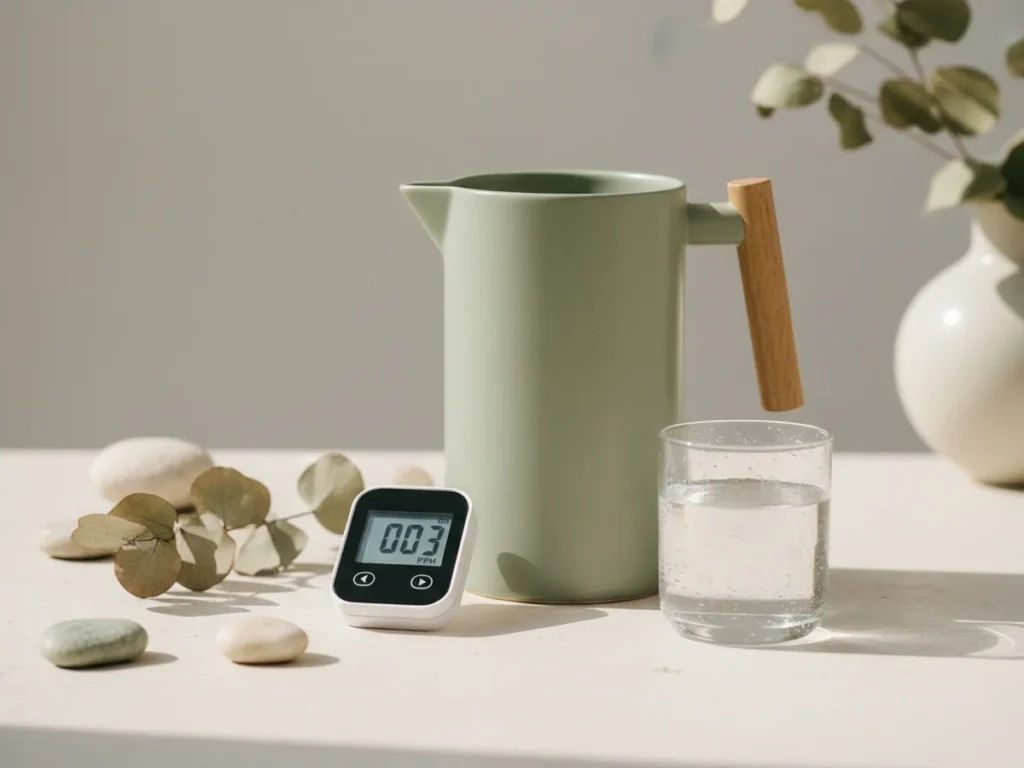
ZeroWater (now sold under Culligan) is a pour-through pitcher that uses a five-stage filter, the standout stage being a mixed-bed ion-exchange resin. That resin is why ZeroWater reduces total dissolved solids by around 99%, far more than a typical single-stage carbon pitcher, and why it ships with a TDS meter so you can watch the reading. It also includes activated carbon and physical filtration layers.
What it is certified to remove
ZeroWater’s five-stage filter is certified by IAPMO against NSF/ANSI 42 (chlorine taste and odor) and NSF/ANSI 53 (reduction of lead, hexavalent chromium, mercury, and PFOA/PFOS). That is a strong list for a pitcher, especially the lead and PFOA/PFOS reduction. These are the claims backed by independent testing. See the best water filter for PFAS.
The microplastics question
Here is the honest part. ZeroWater’s multi-stage filtration is fine enough that it very likely captures a good share of microplastics, and some older or specific ZeroWater products have carried microplastic-related listings. But the current standard pitcher and dispenser models are not certified to NSF/ANSI 401, the standard that specifically verifies microplastic and emerging-contaminant reduction. So the right way to state it is: probably effective, but not formally proven for microplastics on today’s pitcher line. See water filters for microplastics.
If microplastics are your main concern
When microplastics are the specific thing you want gone with certainty, choose by certification rather than inference. A filter certified to NSF/ANSI 401 has been lab-tested for microplastic reduction, and a reverse-osmosis system removes around 99% of microplastics by membrane size alone. Either gives you proof rather than a reasonable assumption. See reverse osmosis for microplastics.
Where ZeroWater still makes sense
None of this means ZeroWater is a poor choice. If your priorities are very low TDS, lead reduction, and PFOA/PFOS reduction in an inexpensive pitcher with no installation, it performs well and is certified for exactly those. The main caveats are practical: the resin exhausts relatively quickly (the TDS meter will tell you), and water flows slowly through the dense filter. Just do not assume the microplastics claim is certified. See activated carbon water filters.
FAQ
Does ZeroWater remove microplastics?
Its fine five-stage filtration likely reduces many microplastics, but current pitcher models are not certified to NSF/ANSI 401, the microplastics standard, so removal is plausible rather than independently proven for today’s line.
What is ZeroWater actually certified to remove?
ZeroWater’s five-stage filter is certified to reduce chlorine taste and odor (NSF 42) and lead, hexavalent chromium, mercury, and PFOA/PFOS (NSF 53), and it reduces total dissolved solids by about 99%.
Is ZeroWater better than Brita for microplastics?
ZeroWater’s denser five-stage filter is more thorough than a basic single-stage pitcher, so it likely captures more particles. But neither basic pitcher is a substitute for a filter certified to NSF/ANSI 401 if microplastics are your specific concern.
What filter is certified for microplastics?
Look for NSF/ANSI 401 certification, which specifically verifies microplastic and emerging-contaminant reduction, or use a reverse-osmosis system, which removes about 99% of microplastics by membrane size.
Why does ZeroWater filter so slowly?
The dense five-stage filter, including the ion-exchange resin that drives its low TDS results, restricts flow. The resin also exhausts relatively quickly, which the included TDS meter helps you track so you know when to replace it.
The bottom line
ZeroWater is a capable, certified pitcher for TDS, lead, and PFOA/PFOS, and it probably reduces microplastics too, but “probably” is the operative word, since current models are not NSF/ANSI 401 certified for them. If microplastics are your priority and you want proof, pick a 401-certified filter or reverse osmosis. See the best water filter for microplastics.