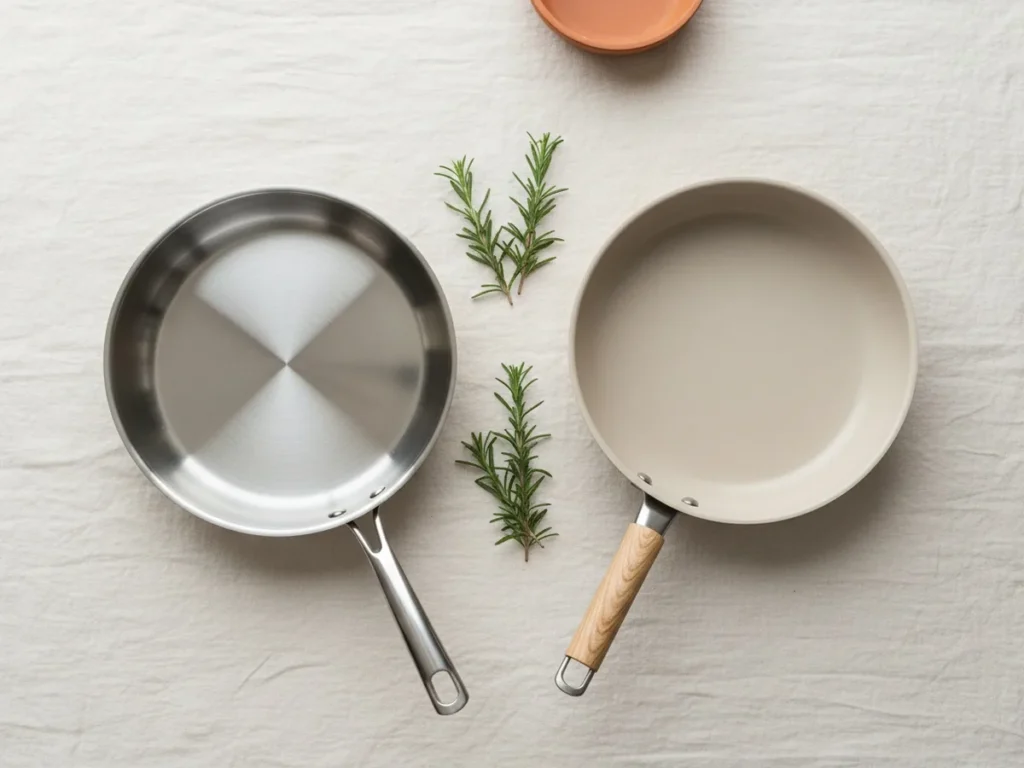
Stainless steel and ceramic are the two cookware materials people reach for when they want to step away from worn-out nonstick, and the honest answer to which one wins depends on the job in front of you.
The short version: for a do-everything, buy-it-for-life pan that sears, builds pan sauces, and lasts decades, uncoated stainless steel is the better choice because it has no coating that can fail. For easy, low-fat eggs and pancakes with minimal cleanup, a ceramic-coated pan is more forgiving in the moment, but that nonstick surface is a consumable that typically wears out in roughly one to three years. Before comparing them, it helps to separate two very different things people both call “ceramic”: a thin ceramic-nonstick coating (the common, affordable kind) versus solid ceramic cookware fired from clay. This guide focuses mostly on the ceramic-coated pans you will actually find on store shelves, since that is what most shoppers are weighing against stainless.
Key takeaways
- Stainless steel lasts longest. With no coating to scratch off, a quality stainless pan can serve for decades, while a ceramic nonstick coating commonly degrades within one to three years.
- Both avoid PFAS. Uncoated stainless has no chemical coating at all, and ceramic-nonstick (sol-gel) coatings are made without PFAS, unlike traditional PTFE nonstick.
- Ceramic wins on day-one nonstick; stainless wins on searing, browning, and high-heat cooking that builds flavor.
- The smartest kit is usually two materials, not two coatings: stainless steel for everyday cooking plus seasoned cast iron for naturally nonstick, high-heat jobs.
What is the real difference between stainless steel and ceramic cookware?
Uncoated stainless steel cookware is solid metal all the way through, usually an alloy of iron with chromium and nickel, often bonded around an aluminum or copper core for even heating. There is no surface layer to wear off, which is why stainless is the workhorse of restaurant kitchens.
“Ceramic” cookware comes in two forms that behave very differently. The first and most common is ceramic-coated metal, where a thin sol-gel coating (essentially a silica-based, sand-derived layer) is sprayed onto an aluminum or steel pan to create a slick, nonstick surface. The second is solid ceramic, fired entirely from clay, which is heavy, brittle, and far less common in everyday kitchens. When most articles say “ceramic vs stainless steel pans,” they mean the ceramic-coated kind, and so does most of this comparison.
Stainless steel vs ceramic-coated cookware: the head-to-head
| Factor | Stainless steel (uncoated) | Ceramic-coated |
|---|---|---|
| Safety | No coating to fail; can leach trace nickel and chromium, generally below allergy thresholds for most people | PFAS-free coating; safe while intact, performance depends on coating staying undamaged |
| Durability / lifespan | Decades; dishwasher-safe; tolerates metal utensils | Roughly 1 to 3 years before the nonstick fades; coating is a consumable |
| Nonstick / performance | Not nonstick; excels at searing, browning, deglazing, and pan sauces | Excellent nonstick when new; ideal for eggs and low-fat cooking; nonstick declines as it ages |
| Heat tolerance | Very high; oven and broiler safe, no coating to scorch | Moderate; high heat is the fastest way to ruin the coating; best on low to medium |
| Maintenance | Scrub freely, dishwasher and metal-utensil friendly | Hand wash, soft utensils, gentle heat, no abrasive cleaners |
| Cost | Higher up front; lowest cost over its lifetime | Lower up front; recurring cost as pans need replacing |
Is stainless steel or ceramic safer and more non-toxic?
This is the question that brings most people to the comparison, and the reassuring news is that neither material relies on the chemistry that made older nonstick controversial. Traditional PTFE nonstick (Teflon) was historically made using PFOA, a PFAS compound. Under the EPA’s 2010/2015 PFOA Stewardship Program, the major manufacturers committed to eliminating PFOA from their products by 2015, so PFOA is no longer used to make this cookware. PFAS as a broader category, however, remains a live concern with coated nonstick, which is part of why both stainless and ceramic appeal to low-tox shoppers. You can read more in our guide to PFAS in cookware and the background on what PFAS actually are.
Uncoated stainless steel has the simplest safety story: there is no coating, so there is nothing to scratch off into food. It can release small amounts of nickel and chromium, especially with acidic foods and brand-new pans. A 2013 study in the Journal of Agricultural and Food Chemistry by Kamerud and colleagues measured this directly, finding that simmering tomato sauce for hours in stainless raised nickel and chromium several-fold, with leaching highest in new pans and decreasing after repeated use, stabilizing after about the sixth cooking cycle. The authors concluded the amounts are generally below allergy-triggering thresholds for the general population, while noting that people with diagnosed nickel sensitivity may want to be more cautious. In practice, that means stainless is a safe everyday choice for most people.
Ceramic-coated pans are PFAS-free, which is their headline safety advantage over conventional PTFE nonstick. The caveat is that their safety profile is tied to the coating staying intact, and that coating does not last forever. If you are weighing ceramic specifically, we go deeper in is ceramic cookware safe.
How long does each one last?
This is where the gap is widest. A well-made stainless steel pan can last for decades because there is no surface layer to degrade; you can scrub it, run it through the dishwasher, and use metal utensils without worry. Ceramic nonstick coatings, by contrast, are best thought of as consumable. Industry and review sources broadly put a quality ceramic coating’s useful nonstick life at around one to three years, and high heat, cooking sprays, and abrasive cleaning shorten that further. A budget ceramic pan used roughly may stop releasing food within a year.
The durability difference also explains the waste math. Replacing a ceramic pan every couple of years adds up, both in money and in discarded cookware, while a single good stainless pan can outlive most of the appliances in your kitchen.
Which one cooks better?
Performance depends on what you are cooking. Stainless steel is the better performer for searing steak, browning chicken, building fond for pan sauces, and any high-heat task, because the bare metal surface encourages the browning reactions that create flavor. The trade-off is that stainless is not nonstick, so delicate foods like eggs and fish need adequate fat, proper preheating, and a little technique to keep from sticking.
Ceramic-coated pans flip those strengths. They make low-fat eggs, omelets, pancakes, and crepes genuinely easy, with food sliding off and cleanup taking seconds, which is a real advantage day to day. But the nonstick effect fades as the coating ages, and ceramic does not love high heat the way stainless does, so it is the weaker choice for serious searing.
What about heat tolerance and maintenance?
Stainless steel shrugs off heat. It is oven-safe and broiler-safe with no coating to scorch, so you can sear on the stovetop and finish in the oven in the same pan. Maintenance is forgiving: scrub stuck-on bits, use metal tools, and put it in the dishwasher.
Ceramic coatings are the opposite on both counts. High heat is the single fastest way to wear out the coating, so manufacturers recommend low to medium settings, and letting a ceramic pan sit empty on a hot burner degrades it quickly. Maintenance has to be gentle too: hand washing, soft or silicone utensils, and no abrasive scrubbers if you want the coating to reach the upper end of its lifespan.
So which should you buy?
If you want one pan to do almost everything and last a lifetime, choose uncoated stainless steel. If your priority is effortless eggs and low-fat cooking with minimal cleanup, and you accept replacing the pan every couple of years, a ceramic-coated pan earns its place. The practical recommendation we make most often, though, is to skip the idea of owning two coatings and instead own two materials for two jobs: stainless steel for everyday cooking and a seasoned cast iron pan for naturally nonstick, high-heat work. That pairing covers nearly every task without any coating that wears out. For the full lineup of options, see our pillar guide to non-toxic cookware.
Frequently asked questions
Is stainless steel or ceramic better?
For durability, high-heat cooking, and a buy-it-for-life pan, stainless steel is better because it has no coating to fail and can last decades. For easy, low-fat nonstick cooking like eggs, ceramic-coated is better in the short term, though its nonstick surface typically wears out in about one to three years.
Is ceramic cookware really non-toxic?
Ceramic-nonstick coatings are made without PFAS, which is their main advantage over traditional PTFE nonstick. They are considered safe while the coating is intact, but because the coating wears down over a few years, the non-toxic benefit depends on replacing pans before the surface degrades.
Does stainless steel leach metals into food?
It can leach trace amounts of nickel and chromium, more so with acidic foods and brand-new pans. A 2013 Journal of Agricultural and Food Chemistry study by Kamerud and colleagues found leaching was highest in new pans and dropped after repeated use, with amounts generally below allergy thresholds for the general population. People with diagnosed nickel sensitivity may want to take more care.
Why does ceramic nonstick wear out so fast?
The slick sol-gel ceramic layer is thin and breaks down with high heat, cooking sprays, metal utensils, and abrasive cleaning. Most quality ceramic coatings keep their nonstick performance for roughly one to three years, which is why ceramic pans are best treated as consumables rather than lifetime cookware.
Should I own both stainless steel and ceramic?
You can, but a better long-term setup for most kitchens is stainless steel plus seasoned cast iron. That combination handles searing, sauces, eggs, and high-heat cooking without relying on any coating that needs replacing every couple of years.
The bottom line
Stainless steel and ceramic-coated cookware solve different problems. Stainless is the durable, high-performance, no-coating choice that rewards you for decades and suits almost every task once you learn its quirks. Ceramic-coated pans are the easy-nonstick choice for eggs and low-fat cooking, PFAS-free and pleasant to use, but consumable by nature. If you only buy one thing, make it good stainless steel. If you want to cover every job without a coating on a countdown, pair that stainless pan with seasoned cast iron and you will rarely need anything else.