If you want one clear answer, here it is: the safest cookware materials are the simple, stable ones that do not shed coatings or react with food.
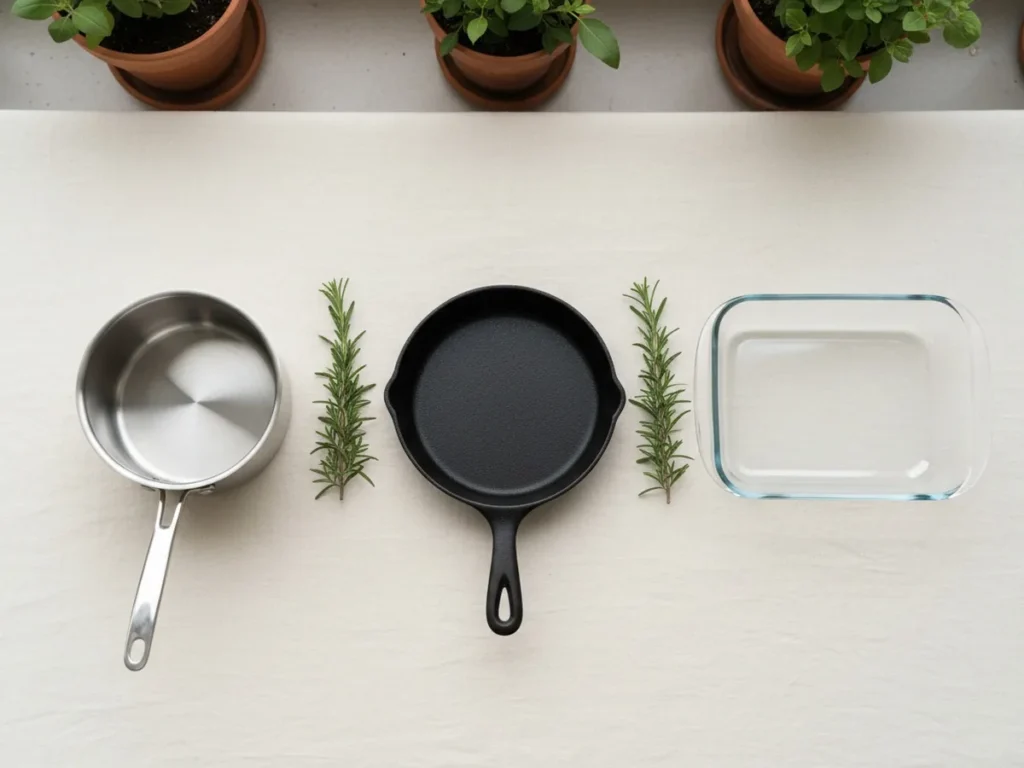
The materials that consistently rank safest are stainless steel, cast iron, carbon steel, 100% solid ceramic, tempered glass, and lead-tested enameled cast iron. These either do not have a coating that can fail, or the coating is glass-like and inert. In the conditional middle sits PFAS-free ceramic-coated cookware, which is genuinely safe to cook on but wears out in a few years. The materials worth caution are traditional PTFE nonstick when scratched or overheated, bare aluminum that reacts with acidic food, and untested glazed or decorative ceramic that can leach lead. Below is the full ranking, the reasoning behind each tier, and what the published evidence actually says.
Key takeaways
- The safest cookware is uncoated and chemically stable: stainless steel, cast iron, carbon steel, solid ceramic, and tempered glass top the list.
- Stainless steel can leach small amounts of nickel and chromium, but a 2013 Oregon State University study found leaching drops with use and stabilizes after about the sixth cooking cycle.
- Traditional PTFE nonstick is fine when intact and used at normal heat, but a 2022 study found a single scratch can release roughly 9,100 plastic particles, so a damaged pan should be retired.
- The real lead risk is not a kitchen brand but untested glazed or imported decorative ceramic. The FDA tests pottery for leachable lead under a 24-hour acetic acid extraction method.
Cookware safety ranking, safest first
| Material | Safety rating | Why | Best for | Watch out for |
|---|---|---|---|---|
| Stainless steel | Safest | No coating to fail, durable, heat-stable | Everyday searing, sauces, boiling, all-purpose | Trace nickel or chromium leaching in new pans, mostly with long acidic cooking |
| Cast iron | Safest | Bare metal, naturally nonstick when seasoned, no synthetic coating | Searing, baking, high-heat cooking, slow cooking | Adds dietary iron, which is a concern only for people who must limit iron |
| Carbon steel | Safest | Like cast iron but lighter, bare metal, seasoned surface | Stir-frying, eggs, high-heat pan work | Needs seasoning and dry storage to avoid rust |
| 100% solid ceramic | Safest | Fired clay, inert when made for food use, no metal substrate | Baking, braising, oven-to-table dishes | Brittle; only buy food-grade, lead-tested pieces |
| Tempered glass | Safest | Inert, nonreactive, no leaching, see-through | Baking, casseroles, storage, reheating | Thermal shock can shatter it; avoid sudden temperature changes |
| Enameled cast iron (lead-tested) | Safest | Glass enamel seals the iron, nonreactive, easy to clean | Braising, soups, acidic dishes, slow cooking | Chipped enamel exposes bare iron; verify the brand is lead-tested |
| PFAS-free ceramic-coated | Conditional | Genuinely nonstick and PFAS-free, but the coating degrades | Eggs, low-fat cooking, easy release | The nonstick layer wears out in roughly 1 to 3 years and then needs replacing |
| Traditional PTFE nonstick | Caution | Safe when intact and at normal heat, but the coating can break down | Quick, low-heat, occasional nonstick tasks | Retire if scratched or overheated; a scratch can shed thousands of particles |
| Bare aluminum | Caution | Lightweight and conductive, but reactive with acidic foods | Better when anodized or clad, not bare | Bare surfaces can react with tomato, citrus, and vinegar |
| Untested glazed / decorative ceramic | Avoid for cooking | Glaze may contain lead or cadmium that leaches into food | Decoration only, not food contact | Imported, antique, handmade, or decorative-only pieces are the main lead risk |
What is the safest cookware material?
The safest cookware material is one that stays chemically stable when heated and does not rely on a coating that can wear off into your food. By that test, stainless steel, cast iron, and carbon steel lead the field, alongside inert materials like solid ceramic and tempered glass. None of these has a synthetic nonstick layer to degrade, scratch, or flake. They are the materials professional kitchens lean on precisely because they last for decades and behave predictably under heat.
Coatings are where most safety questions come from. A coating introduces something between the metal and your food, and any coating can eventually fail. So the simplest path to safe cooking is to favor materials that have no coating at all, or a coating that is essentially glass, such as the enamel on lead-tested enameled cast iron.
Is stainless steel the safest cookware?
Stainless steel is the strongest all-around pick for most kitchens. It does not have a coating that can chip, it tolerates very high heat, and it lasts a lifetime. The one nuance worth understanding is metal leaching. A 2013 study by Kamerud, Hobbie, and Anderson at Oregon State University, published in the Journal of Agricultural and Food Chemistry, measured nickel and chromium leaching when tomato sauce was cooked in stainless steel. Leaching was highest in new pans and during long cooking times, then decreased with repeated use and stabilized after about the sixth cooking cycle.
For most people this is not a meaningful concern, since the amounts are small and the surface effectively conditions itself with use. The main group that should pay attention is people with a diagnosed nickel allergy, who may prefer to limit long, acidic simmering in brand-new stainless pans. For everyone else, stainless steel remains a safest-tier choice. If you are weighing it against coated options, see our comparison of stainless steel vs ceramic cookware.
Are cast iron and carbon steel safe?
Yes. Both are bare metal with no synthetic coating, which is exactly why they sit in the safest tier. A well-seasoned cast iron or carbon steel pan develops a natural, polymerized oil layer that releases food cleanly without any manufactured nonstick chemistry. Cast iron does transfer a small amount of dietary iron into food, especially with acidic dishes, which is usually a minor benefit rather than a risk. The only people who should be cautious are those with a medical reason to restrict iron intake, such as hemochromatosis. Carbon steel behaves similarly but is lighter and heats faster, which makes it a favorite for stir-frying and eggs.
Is ceramic cookware the healthiest material?
This is where the word ceramic causes confusion, because it describes two very different things. 100% solid ceramic, fired clay made for food use, is inert and sits in the safest tier. Ceramic-coated cookware is a metal pan sprayed with a thin sol-gel mineral layer. That coating is PFAS-free and safe to cook on, but it is not permanent. Most ceramic nonstick coatings lose their release performance within roughly one to three years and then need replacing, which is why we rate it conditional rather than safest. It is a fine choice if you accept that it is a consumable item. For a deeper look at the coating chemistry and how to buy it well, read is ceramic cookware safe.
What cookware should you avoid?
Three categories deserve real caution.
First, traditional PTFE nonstick, commonly known by the Teflon name, once you damage it. PTFE itself is stable at normal cooking temperatures, and the PFOA once used to manufacture it was phased out under the EPA PFOA Stewardship Program, which eight major manufacturers completed by 2015. The concern today is physical breakdown. A 2022 study published in Science of the Total Environment used Raman imaging to estimate that a single scratch on a nonstick coating can release roughly 9,100 microplastic and nanoplastic particles, and a badly broken coating can release on the order of 2.3 million. The practical rule is simple: never preheat a nonstick pan empty, keep the heat moderate, use non-metal utensils, and retire any nonstick pan once it is scratched or flaking. For the full picture on fluorinated chemistry, see our guide to PFAS in cookware.
Second, bare aluminum. It is lightweight and conducts heat well, but the unprotected surface can react with acidic foods like tomato and citrus. Anodized or fully clad aluminum, where the cooking surface is sealed or bonded to stainless, avoids this problem and is a much safer way to get aluminum’s heat performance.
Third, and most important for lead, untested glazed or decorative ceramic. The genuine lead hazard in kitchens is rarely a mainstream cookware brand. It is imported traditional pottery, antique pieces, handmade glazed ware, and items labeled for decoration only. The FDA tests pottery for leachable lead under Compliance Policy Guide 545.450 using a 24-hour extraction with 4% acetic acid, and pieces that exceed the action levels are not meant for food. If a glazed piece is decorative, vintage, or of unknown origin, do not cook or store acidic food in it. To choose specific products with confidence, use our non-toxic cookware buying guide.
Frequently asked questions
What is the safest cookware to cook with every day?
For daily, all-purpose cooking, stainless steel is the safest practical choice because it has no coating to wear off and lasts for decades. Cast iron and carbon steel are equally safe and add natural nonstick performance once seasoned. If you want easy release for eggs, a PFAS-free ceramic-coated pan is reasonable, as long as you accept that you will replace it every few years.
Is stainless steel or nonstick safer?
Stainless steel is the safer long-term material because it does not depend on a coating. Nonstick is acceptable when the coating is intact and used at moderate heat, but it becomes a concern once scratched. A 2022 Science of the Total Environment study estimated about 9,100 particles released from a single scratch, which is why a damaged nonstick pan should be replaced.
Does stainless steel leach metals into food?
It can leach small amounts of nickel and chromium, especially in new pans during long, acidic cooking. The 2013 Oregon State University study by Kamerud and colleagues found this leaching is highest when pans are new and decreases with repeated use, stabilizing after roughly the sixth cooking cycle. For most people the amounts are minor; those with a nickel allergy may prefer to limit long acidic simmering in brand-new pans.
Is ceramic cookware safe and the healthiest option?
It depends which ceramic you mean. Solid, food-grade ceramic is inert and among the safest materials. Ceramic-coated cookware is PFAS-free and safe to cook on, but the nonstick layer typically wears out within one to three years. It is a good option if you treat it as a consumable rather than a lifetime pan.
How do I know if glazed ceramic has lead?
Treat imported traditional pottery, antiques, handmade glazes, and decoration-only pieces as suspect, and do not use them for cooking or acidic food. The FDA screens pottery for leachable lead using a 24-hour 4% acetic acid extraction under Compliance Policy Guide 545.450. Mainstream cookware sold for food use in regulated markets is the lower-risk choice, and home lead test swabs can offer a rough first check.
The bottom line
The safest cookware is the least complicated cookware. Materials that are stable and uncoated, stainless steel, cast iron, carbon steel, solid ceramic, tempered glass, and lead-tested enameled cast iron, do not have a coating that can fail into your food, and the evidence on each is reassuring. PFAS-free ceramic coatings are safe to cook on but are a consumable you will replace. The materials to handle with care are scratched or overheated PTFE nonstick, bare aluminum with acidic foods, and untested glazed or decorative ceramic, which is the real source of lead risk. Choose stable materials, retire damaged pans, and you have covered the great majority of cookware safety. When you are ready to pick specific products, start with our non-toxic cookware buying guide.