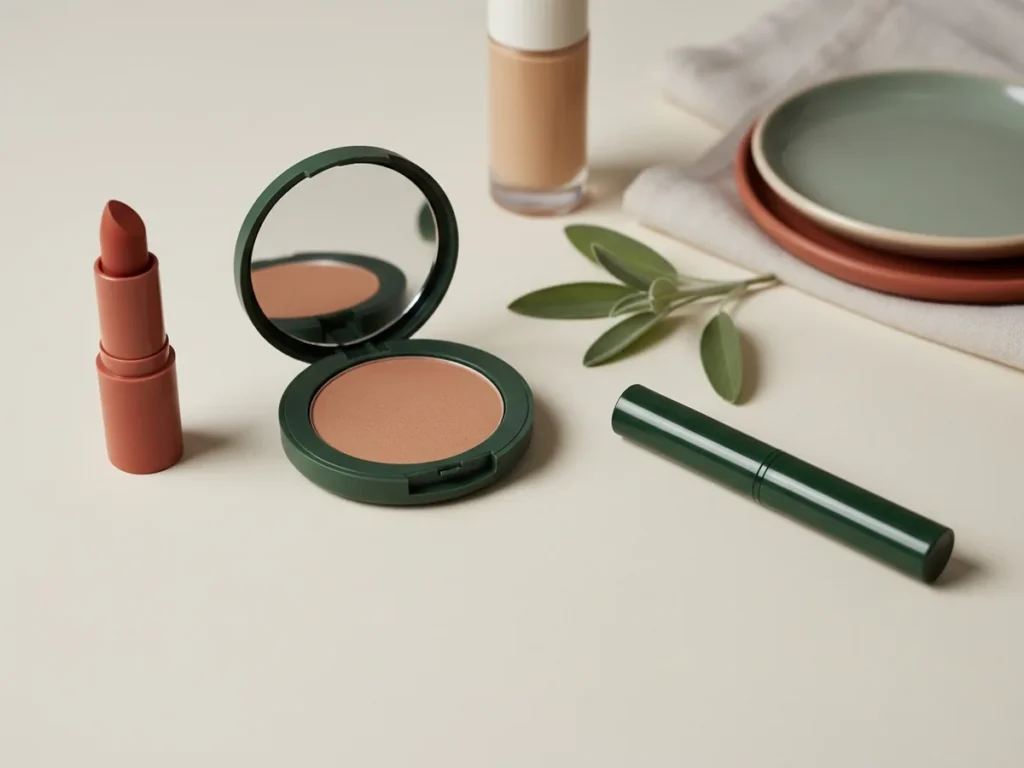
PFAS show up most often in long-wear and waterproof cosmetics, especially waterproof mascara, liquid lipstick, and long-lasting foundation. A 2021 study of 231 makeup products found measurable fluorine, a strong marker of PFAS, in a majority of these categories, yet almost none of the products named PFAS on the label. Brands add these compounds because they help makeup resist water, stay put, and spread smoothly. The good news is that PFAS-free formulas are widely available, and a few label habits make them easy to find.
Key takeaways
– PFAS are used in cosmetics for durability, water resistance, and smooth application, so they cluster in waterproof and long-wear products.
– A 2021 Notre Dame study found measurable fluorine in 82% of waterproof mascaras, 63% of foundations, and 62% of liquid lipsticks tested, but only 8% of all products listed PFAS on the label.
– You can screen products yourself by scanning ingredient lists for PTFE and any word containing “fluoro,” “perfluoro,” or “polyfluoro.”
Why do cosmetics contain PFAS in the first place?
PFAS, short for per- and polyfluoroalkyl substances, are a large family of synthetic chemicals prized for repelling water and oil and for their slick, film-forming texture. Those same traits are useful in makeup. In cosmetics they can improve wear time, make a foundation glide on evenly, keep mascara from smudging in the rain, and give products a soft, silky feel. If you want a broader primer, see what PFAS are and where they come from.
Because these properties matter most in products designed to last, PFAS tend to concentrate in the “long-lasting,” “wear-resistant,” and “waterproof” corners of the beauty aisle. The chemistry that keeps a lip color from transferring onto a coffee cup is often the same chemistry that resists soap and water everywhere else.
Which makeup products are most likely to contain PFAS?
The clearest picture comes from a 2021 study published in Environmental Science & Technology Letters, led by researchers at the University of Notre Dame. The team screened 231 cosmetic products bought in the United States and Canada for total fluorine, an indicator of probable PFAS content. Just over half of all products tested showed high fluorine levels.
The concentration was highest in the categories you might expect. Roughly 82% of waterproof mascaras, 63% of foundations, and 62% of liquid lipsticks contained measurable fluorine. Products marketed as “long-lasting” and “wear-resistant” tended to have the highest levels. The table below summarizes where PFAS are most and least likely to appear.
| Product type | Relative likelihood of PFAS | Why |
|---|---|---|
| Waterproof mascara | Higher | Water resistance is the core selling point |
| Long-wear liquid foundation | Higher | Long wear and smooth spread |
| Liquid or transfer-proof lipstick | Higher | Durability and slip |
| Powder blush and eyeshadow | Moderate | Sometimes used for texture |
| Basic non-waterproof, non-long-wear products | Lower | Fewer durability claims to engineer for |
How can you spot PFAS on a cosmetics label?
Ingredient lists are your best tool, with one important caveat. In the Notre Dame study, only about 8% of the products tested actually listed PFAS on the label, even though a majority contained measurable fluorine. So a clean-looking label is reassuring but not a guarantee.
When PFAS are disclosed, they show up under a handful of recognizable patterns. Scan for these:
| Label term | What it signals |
|---|---|
| PTFE (polytetrafluoroethylene) | A common PFAS, also known as the nonstick coating polymer |
| Any word starting with “perfluoro” | Direct PFAS marker, e.g. perfluorodecalin |
| Any word starting with “polyperfluoro” or “polyfluoro” | Fluorinated polymer or compound |
| Any ingredient containing “fluoro” | General flag worth checking further |
A practical rule: if you see “fluoro” anywhere in an ingredient name, treat it as a likely PFAS and decide accordingly. The same label-reading habit works across product categories, and it pairs well with the wider strategies in our guide on how to avoid PFAS at home.
What is the health and exposure concern?
PFAS are often called “forever chemicals” because they break down very slowly and can build up in the body and the environment over time. With cosmetics, the concern is chronic, low-level exposure through several routes: ingestion from lip products, absorption around the eyes and through skin, and inhalation of powders or sprays.
It is worth being measured here. In a December 2025 report, the U.S. Food and Drug Administration concluded that it could not reach definitive safety determinations for most of the PFAS it evaluated in cosmetics, citing significant gaps in the available toxicology data. That is not the same as a clean bill of health, and it is not proof of harm from any single product. It reflects genuine scientific uncertainty. For people who prefer to reduce exposure while the science develops, cutting PFAS from daily-use products is a reasonable, low-cost step. If you are also thinking about existing body burden, see our overview of how to reduce PFAS in your body.
What are regulators doing about PFAS in cosmetics?
Action is uneven and still developing. At the state level, California passed the PFAS-Free Cosmetics Act, known as AB 2771. Signed into law in 2022, it prohibits selling cosmetics with intentionally added PFAS in California starting January 1, 2025, and it applies broadly across the PFAS class rather than to a short list of named chemicals.
At the federal level, the “No PFAS in Cosmetics Act” has been introduced in Congress more than once, including in 2021 and again in 2023. As of this writing it has not passed into law, so there is still no nationwide ban. Internationally, the European Union is weighing a broad PFAS restriction proposal, first submitted by five member states in 2023, that would cover cosmetics among many other product sectors. That proposal is still under review and has not been finalized. In short, momentum is building, but consumers currently carry much of the burden of avoidance.
How do you choose PFAS-free cosmetics?
You do not need a chemistry degree to lower your exposure. Start with the categories most likely to contain PFAS and prioritize swaps there: waterproof mascara, transfer-proof and liquid lipsticks, and long-wear foundations. Choosing standard versions over “waterproof” or “24-hour” claims removes much of the incentive for a brand to formulate with PFAS in the first place.
From there, read labels for the “fluoro” family of terms and PTFE, and favor brands that publicly state their products are PFAS-free. Because labels can be incomplete, brand transparency and third-party testing carry real weight. The habit of scanning ingredients transfers neatly to other product categories too, including PFAS in clothing and household goods, so the effort compounds over time.
FAQ
Does all makeup contain PFAS?
No. PFAS are concentrated in waterproof and long-wear products, while many everyday cosmetics contain none. Reading ingredient lists and choosing non-waterproof, non-long-wear versions substantially lowers the odds.
What ingredient names indicate PFAS in cosmetics?
Look for PTFE and any ingredient containing “fluoro,” “perfluoro,” “polyperfluoro,” or “polyfluoro.” If you see “fluoro” anywhere in an ingredient name, treat it as a likely PFAS.
Why do brands add PFAS to mascara and foundation?
They improve water resistance, wear time, and smooth application. Those traits matter most in waterproof mascara, long-wear foundation, and transfer-proof lipstick, which is why PFAS cluster in those categories.
Is PFAS in cosmetics banned in the United States?
There is no federal ban yet. California prohibits intentionally added PFAS in cosmetics sold in the state starting January 1, 2025, and other states are considering similar rules, but a nationwide bill has not passed.
Are PFAS-free cosmetics just as good?
For most everyday use, yes. PFAS-free foundations, mascaras, and lipsticks are widely available and perform well. The main trade-off is that some may be less extreme in water resistance or all-day wear.