You can have a nonstick cooking surface without the chemistry that worries people. You just have to be careful about what “nonstick” means.
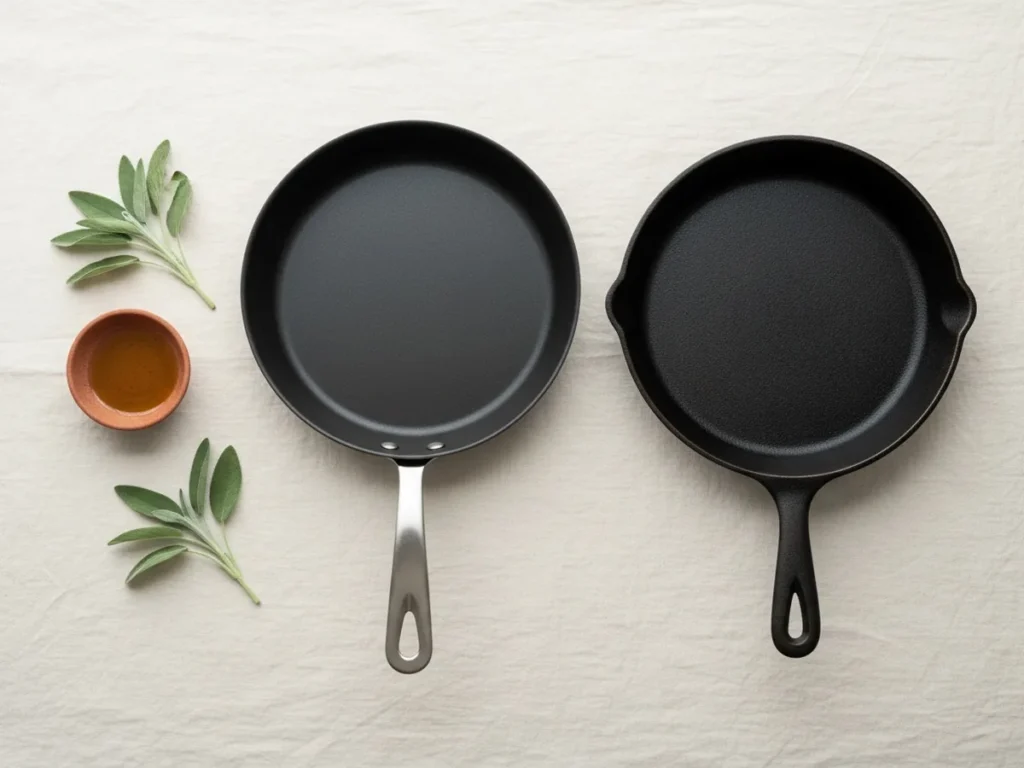
Yes, a nonstick pan can be genuinely non-toxic, but only if you broaden the definition beyond the slick black coating most people picture. Conventional PTFE (Teflon-style) nonstick is far less alarming than the internet suggests, yet it still has real downsides: it can shed particles when scratched and release fumes if badly overheated. The truly non-toxic routes to an easy-release surface are seasoned cast iron, carbon steel, and, for shorter-term convenience, a PFAS-free ceramic-coated pan. This guide explains the difference and gives you a clear pick.
Key takeaways
- Modern PTFE nonstick has been PFOA-free since 2013, but it can still release particles when scratched and toxic fumes when overheated past about 500°F (260°C).
- For a buy-it-for-life non-toxic nonstick surface, season cast iron or carbon steel: they build a natural release layer from baked-on oil, with no coating at all.
- PFAS-free ceramic-coated pans are a real non-toxic option and the most convenient, but the coating typically wears out in 1 to 3 years.
- The safest pan is the one used correctly: never preheat an empty pan, keep heat at medium, and retire any coated pan once it is scratched.
Can a nonstick pan really be non-toxic?
It depends entirely on how the surface releases food. “Nonstick” is a performance description, not a single material. A factory coating is one way to get there. A baked-on layer of polymerized oil is another. The two carry very different safety profiles.
When people say “non-toxic nonstick,” they usually mean a surface that does not contain or shed per- and polyfluoroalkyl substances, the family known as PFAS. PFAS are sometimes called “forever chemicals” because they break down extremely slowly in the environment and the body. If you want the background, see our explainer on what PFAS are. The good news: PFAS-free release surfaces exist, and some of them outlast everything else in your kitchen.
Why does conventional PTFE nonstick worry people?
The classic black nonstick coating is PTFE (polytetrafluoroethylene), the material branded as Teflon. PTFE is itself a member of the PFAS family. There are three distinct concerns worth separating, because two of them are largely solved and one is real.
The old PFOA problem is gone. Until about a decade ago, PFOA (a separate, well-documented harmful PFAS) was used to manufacture PTFE coatings. Under the U.S. EPA’s 2010/2015 PFOA Stewardship Program, eight major manufacturers including DuPont and 3M agreed to eliminate PFOA, and Teflon-branded products have been PFOA-free since 2013, according to the EPA. So a pan bought today is not coated using PFOA.
Scratching is a genuine issue. A 2022 study by Luo and colleagues in Science of the Total Environment used Raman imaging to show that a single crack or scratch in a Teflon coating can release roughly 9,100 plastic particles, and that a larger area of broken coating could shed millions of micro- and nanoplastic particles. The takeaway is practical: once a coated pan is visibly scratched or flaking, it belongs in the bin, not on the stove. For more on this, see our overview of PFAS in cookware.
Overheating produces fumes. PTFE is stable and inert at normal cooking temperatures, but it begins to break down above about 500°F (260°C), releasing fumes that can cause a temporary flu-like illness called polymer fume fever. An empty pan left on a high burner can reach that temperature within minutes. The fix is simple: never preheat a coated pan empty, and keep the heat at medium or below.
What are the genuinely non-toxic nonstick options?
Three surfaces give you easy food release without a fluoropolymer coating. Two of them are essentially permanent.
| Pan type | Non-toxic? | How it gets nonstick | Lifespan | Best for | Watch out for |
|---|---|---|---|---|---|
| Traditional PTFE (Teflon) nonstick | Conditional. PFOA-free since 2013, but a PFAS material that can shed particles and fume | Factory-applied fluoropolymer coating | 3 to 5 years | Eggs and delicate foods on a budget | Scratches release ~9,100 particles per crack; fumes above 500°F |
| Ceramic-coated nonstick | Yes, if labeled PFAS-free | Sol-gel mineral (silica-based) coating | 1 to 3 years | Convenient everyday cooking, low-fat release | Coating degrades fastest of all; not buy-it-for-life |
| Seasoned cast iron | Yes, no coating at all | Polymerized oil layer baked onto bare iron | Decades to a lifetime | Searing, baking, high heat, longevity | Heavy; needs seasoning upkeep; reacts with very acidic foods |
| Carbon steel | Yes, no coating at all | Polymerized oil layer baked onto bare steel | Decades to a lifetime | Eggs, stir-fry, everyday cooking, lighter than cast iron | Needs seasoning upkeep; reacts with very acidic foods |
How do cast iron and carbon steel become nonstick without a coating?
This is the part most people miss. Cast iron and carbon steel are not “nonstick out of the box,” and they are not coated with anything. Their release surface is built by seasoning: when you heat a thin layer of oil past its smoke point, the oil polymerizes, meaning its fatty-acid chains break apart and reform into a hard, slick layer that bonds directly to the metal and fills its microscopic pores. There are no fluorochemicals involved, only oil and heat.
The advantage over every coated pan is direction of travel. A coating can only degrade with use. A seasoned surface improves with use. Each cooking session adds to the layer, so a carbon steel pan you have cooked on for years has a deeper, slicker surface than the day you bought it. With basic care, both materials last for decades. That is what “buy it for life” actually looks like.
Are PFAS-free ceramic pans a good option?
Yes, with one honest caveat. Ceramic-coated pans use a sol-gel mineral coating (silica-based) rather than a fluoropolymer, so a pan clearly labeled PFAS-free contains no PTFE and no forever chemicals. They release food beautifully when new and require almost no skill, which makes them the most convenient non-toxic pick.
The trade-off is durability. The ceramic surface is the shortest-lived of any nonstick, commonly losing its release performance within 1 to 3 years, after which it needs replacing. Treat a ceramic pan as a convenient consumable, not an heirloom. For a deeper look, read our guide to whether ceramic cookware is safe.
What should you look for, and what should you avoid?
Look for: a clear “PFAS-free” or “PTFE-free and PFOA-free” statement from the manufacturer, not just the vague word “nontoxic.” For cast iron and carbon steel, look for a pan that arrives pre-seasoned or comes with seasoning instructions. For ceramic, look for an oven-safe rating and a realistic warranty.
Avoid: any coated pan that is already scratched, chipped, or flaking; metal utensils on coated surfaces; aerosol cooking sprays, which leave a residue that degrades ceramic coatings; and high, empty preheating on any nonstick pan. If you want a broader plan for reducing exposure, see our guide on how to avoid PFAS and our overview of non-toxic cookware.
Frequently asked questions
Is modern Teflon safe to cook on?
At normal cooking temperatures, intact PTFE is chemically stable and considered inert, and it has been PFOA-free since 2013 per the EPA. The real risks are overheating an empty pan past about 500°F, which can release fumes, and cooking on a scratched coating, which can shed particles. An undamaged pan used at medium heat is low-risk, but it will not last forever.
What is the healthiest nonstick pan you can buy?
For a permanent, coating-free surface, seasoned carbon steel or cast iron is the healthiest choice because there is nothing to wear off or shed. If you want effortless release and do not mind replacing the pan every couple of years, a clearly labeled PFAS-free ceramic pan is the healthiest convenient option.
Are ceramic nonstick pans actually PFAS-free?
Genuine ceramic coatings are silica-based sol-gel layers with no fluoropolymers, so a pan honestly labeled PFAS-free contains no PTFE or PFOA. The caution is marketing: some pans use “ceramic” loosely. Buy from brands that state PFAS-free, PTFE-free, and PFOA-free explicitly.
When should I throw out a nonstick pan?
Retire any coated pan, PTFE or ceramic, as soon as the surface is scratched, chipped, peeling, or no longer releasing food. The 2022 Luo study showed a single scratch in a PTFE coating can release roughly 9,100 particles, so a damaged coating is the point at which a previously low-risk pan stops being worth using.
Does carbon steel really work as well as Teflon?
Once properly seasoned, carbon steel releases eggs and delicate foods very well, and unlike Teflon it keeps improving with use. It demands a little more technique, mainly preheating and a thin film of oil, but it lasts for decades and never needs replacing because of a worn coating.
The bottom line
A nonstick pan can absolutely be non-toxic, as long as you choose the surface deliberately. For a buy-it-for-life answer with zero coating to shed or fume, season cast iron or carbon steel and let the surface get better every year. If you value convenience over longevity, a clearly labeled PFAS-free ceramic pan is a legitimate non-toxic pick, just expect to replace it every 1 to 3 years. Conventional PTFE is not the villain it is often made out to be, but it is the only option here that is both a PFAS material and disposable, so it sits at the bottom of the list. Whatever you cook on, keep the heat moderate, never preheat empty, and retire any coated pan the moment it is scratched. For the full lineup of safe materials, see our guide to non-toxic cookware.